There are few events in the universe as breathtaking—or as meaningful—as a supernova. Imagine a single star suddenly becoming brighter than billions of stars combined. For a few weeks or months, it can outshine an entire galaxy before gradually fading into darkness. To ancient skywatchers, these unexpected “new stars” seemed mysterious and even frightening. Today, scientists know they are witnessing one of nature’s most spectacular finales.
At first glance, a supernova appears to be the ultimate symbol of destruction. A star that may have shone peacefully for millions or even billions of years suddenly tears itself apart in an unimaginably powerful explosion. The blast sends shock waves racing through space, hurls matter across light-years, and leaves behind either an incredibly dense neutron star or an enigmatic black hole.
But hidden within this cosmic destruction is one of the universe’s greatest acts of creation.
Every atom of iron in your blood, the calcium in your bones, the oxygen you breathe, and the gold in your jewelry were forged inside stars. Many of the heaviest elements that make planets—and life itself—were created during supernova explosions. Without these violent stellar deaths, Earth would never have existed. Neither would you.
In one of the universe’s most beautiful paradoxes, stars must die so that new worlds can be born.
This is the extraordinary story of supernova explosions—the deaths of stars that ultimately create life.
What Is a Supernova?
A supernova is the explosive death of a star. During this event, a star releases an enormous amount of energy in a remarkably short period of time. For a brief moment, it may become one of the brightest objects in the universe.
Although astronomers use the single word “supernova,” not all supernovae occur in the same way. Some happen when massive stars collapse under their own gravity after running out of nuclear fuel. Others occur when a dense white dwarf star gains too much mass and undergoes a runaway thermonuclear explosion.
Despite their different origins, both kinds of supernova dramatically transform their surroundings. They release tremendous amounts of light, heat, radiation, and newly created chemical elements into space.
These explosions are among the most energetic events known in nature.
Why Stars Shine in the First Place
To understand why stars explode, it helps to understand why they shine.
Every ordinary star exists because of a delicate balance.
Gravity constantly tries to pull the star inward, squeezing its enormous mass toward the center.
At the same time, nuclear fusion inside the star’s core releases tremendous energy. This energy creates outward pressure that pushes against gravity.
As long as these two forces remain balanced, the star stays stable.
Our Sun has maintained this balance for about 4.6 billion years.
It will continue doing so for roughly another five billion years.
Eventually, however, every star runs out of fuel.
When that happens, gravity begins to win.
For some stars, that marks the beginning of an extraordinary ending.
The Life Cycle of a Star
Stars are born inside giant clouds of gas and dust called nebulae.
Gravity slowly pulls parts of these clouds together.
As material accumulates, pressure and temperature rise.
Eventually the core becomes hot enough for hydrogen atoms to begin fusing into helium.
A star is born.
For most of its life, a star quietly converts hydrogen into helium.
This stage, known as the main sequence, lasts far longer than any other part of a star’s life.
What happens next depends mainly on one factor.
Mass.
The mass of a star determines almost everything about its future.
Small stars live quietly for trillions of years.
Medium-sized stars, like our Sun, become red giants before ending their lives as white dwarfs.
Only the most massive stars experience the spectacular fate known as a supernova.
Massive Stars Live Fast and Die Young
It might seem logical that larger stars should live longer because they contain more fuel.
The opposite is true.
Massive stars burn their fuel at astonishing rates.
Their cores become much hotter than those of smaller stars.
Higher temperatures cause nuclear fusion to proceed much more rapidly.
As a result, stars many times more massive than the Sun may live only a few million years.
Compared to the Sun’s expected lifetime of about ten billion years, that is remarkably short.
These stellar giants burn brightly—but briefly.
The Beginning of the End
Inside a massive star, fusion gradually creates heavier and heavier elements.
Hydrogen becomes helium.
Helium becomes carbon.
Carbon forms oxygen.
Later stages create neon, magnesium, silicon, sulfur, and several other elements.
Each stage occurs more quickly than the last.
Eventually, the core begins producing iron.
This changes everything.
Why Iron Changes the Story
Most nuclear fusion reactions release energy.
That energy supports the star against gravity.
Iron is different.
Fusing iron into heavier elements requires energy instead of releasing it.
Once the core becomes mostly iron, the star loses its primary energy source.
Outward pressure weakens.
Gravity suddenly takes control.
The collapse begins.
The Core Collapse
Once the iron core becomes too massive to support itself, it collapses with astonishing speed.
The collapse occurs in less than a second.
Imagine a core larger than Earth shrinking into an object only about twenty kilometers across.
Matter falls inward at enormous speeds.
Temperatures soar into the billions of degrees.
Electrons and protons combine to form neutrons.
The collapsing core becomes unimaginably dense.
A teaspoon of neutron-star material would weigh billions of tons on Earth.
Eventually the collapse suddenly stops.
The dense core cannot be compressed much further.
Material crashing inward slams into this nearly incompressible core.
A powerful shock wave forms.
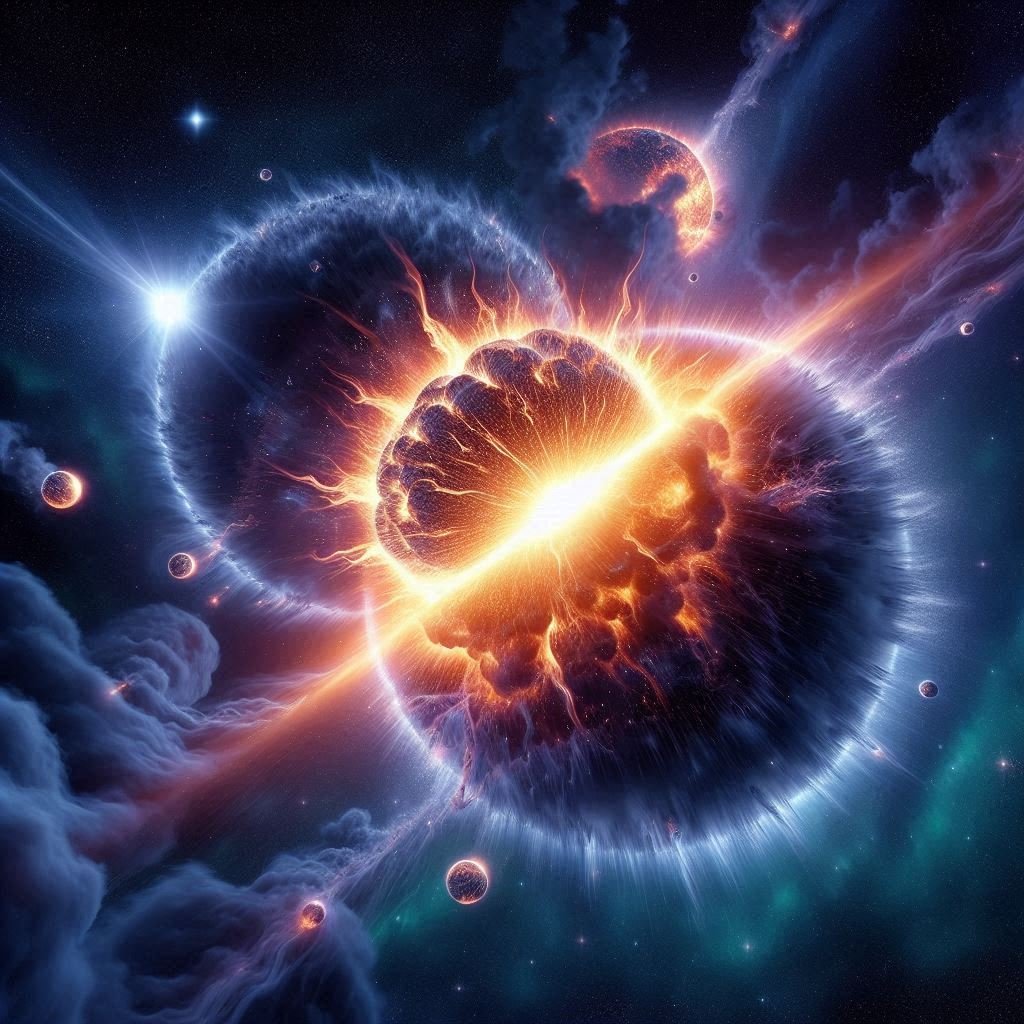
The star explodes.
One of the Most Powerful Explosions in Nature
A core-collapse supernova releases an extraordinary amount of energy.
For a brief period, it can shine brighter than an entire galaxy containing hundreds of billions of stars.
Most of the explosion’s energy actually leaves as tiny particles called neutrinos.
Trillions upon trillions of neutrinos pass through Earth every second without interacting.
During a supernova, the number becomes almost unimaginable.
Only a tiny fraction of the released energy appears as visible light.
Yet that tiny fraction alone is enough to illuminate vast regions of space.
What Happens After the Explosion?
The outer layers of the star are blasted into space.
These expanding clouds continue traveling outward for thousands of years.
Astronomers call the glowing remains a supernova remnant.
Meanwhile, the collapsed core survives.
Its ultimate fate depends on how massive it is.
Some become neutron stars.
Others collapse even further into black holes.
Either way, the original star has ended its life forever.
Neutron Stars: Cosmic Cities of Matter
Neutron stars are among the strangest objects in the universe.
Although only about twenty kilometers wide, they often contain more mass than our Sun.
Their density is almost impossible to imagine.
Their gravity is extraordinarily strong.
Many spin incredibly rapidly.
Some rotate hundreds of times every second.
Strong magnetic fields produce beams of radio waves.
If these beams sweep across Earth, astronomers detect regular pulses.
Such objects are called pulsars.
They serve as some of the universe’s most accurate natural clocks.
Black Holes: When Gravity Wins Completely
If the collapsing core is sufficiently massive, even neutron matter cannot resist gravity.
The collapse continues.
Eventually a black hole forms.
Its gravity becomes so intense that nothing—not even light—can escape once it crosses the event horizon.
Black holes represent one of physics’ greatest mysteries.
Although invisible, astronomers detect them by observing how nearby matter behaves.
Many supernovae throughout cosmic history have produced black holes scattered across galaxies.
Not Every Supernova Happens the Same Way
While massive stars produce core-collapse supernovae, another important type follows a completely different path.
It begins with a white dwarf.
A white dwarf is the dense remnant left behind after a Sun-like star ends its life.
Normally white dwarfs remain stable.
But if one orbits another star closely, gravity may pull material from its companion.
Gradually the white dwarf grows heavier.
Eventually it reaches a critical mass.
Runaway nuclear reactions ignite throughout the star almost simultaneously.
Unlike core-collapse supernovae, this explosion completely destroys the white dwarf.
Nothing remains behind.
These explosions are called Type Ia supernovae.
They play an especially important role in astronomy because they reach nearly the same brightness each time, allowing scientists to measure enormous cosmic distances.
The Universe’s Greatest Element Factory
Stars are often called cosmic furnaces.
Inside their hot cores, they create many chemical elements through nuclear fusion.
Hydrogen becomes helium.
Helium produces carbon.
Further reactions create oxygen, neon, magnesium, silicon, sulfur, and other elements.
But ordinary stellar fusion has limits.
It cannot efficiently produce elements heavier than iron.
Something far more energetic is needed.
That something is a supernova.
Where Gold Really Comes From
People often admire gold for its beauty.
Few realize its extraordinary origin.
Creating heavy elements like gold, platinum, uranium, and many rare metals requires enormous numbers of neutrons and incredibly energetic conditions.
Supernovae provide some of those conditions.
Modern research also shows that collisions between neutron stars create many of the universe’s heaviest elements through a process known as rapid neutron capture, or the r-process. Supernovae likely contribute to producing some heavy elements as well, especially in certain explosion environments, but neutron star mergers are now considered a major source of elements such as gold and platinum.
Either way, the jewelry people wear today owes its existence to some of the universe’s most violent events.
We Are Literally Made of Stardust
One of astronomy’s most inspiring discoveries is surprisingly personal.
The atoms inside your body were created long before Earth existed.
Hydrogen formed shortly after the Big Bang.
Carbon formed inside ancient stars.
Oxygen emerged from stellar fusion.
Iron originated in massive stars before being dispersed by supernova explosions.
Calcium, phosphorus, sulfur, and many other elements essential for life also came from generations of stars.
Those elements drifted through interstellar space.
Eventually they became part of giant molecular clouds.
New stars and planets formed from those enriched clouds.
Earth emerged.
Life appeared.
Billions of years later, those same ancient atoms became part of you.
In a very real scientific sense, every human being is made of recycled stardust.
How Supernovae Create New Stars
A supernova does not simply scatter material.
Its expanding shock wave also compresses nearby clouds of gas.
Compression increases density.
Eventually gravity takes over.
New stars begin forming.
In this way, one dying star can trigger the birth of many new ones.
The cycle repeats throughout galaxies.
Stars create elements.
Supernovae spread them.
New stars form from enriched material.
Planets appear.
Life becomes possible.
Death becomes creation.
The Solar System’s Explosive Past
Scientists believe our own Solar System formed from a cloud already enriched by earlier generations of stars.
Evidence comes from radioactive isotopes preserved inside ancient meteorites.
These isotopes suggest that at least one nearby supernova may have exploded shortly before or during the Solar System’s formation.
Its shock wave may even have helped trigger the collapse of the cloud that eventually became the Sun and its planets.
If so, Earth’s story began with an exploding star.
Famous Supernovae in Human History
Throughout history, people have occasionally witnessed supernovae with their own eyes.
One of the most famous appeared in 1054.
Observers in China, Japan, and other regions described a brilliant “guest star.”
It remained visible during daylight for weeks.
Today astronomers know this explosion created the Crab Nebula.
Another famous event occurred in 1572.
The Danish astronomer Tycho Brahe carefully observed a bright new star.
Its appearance challenged the ancient belief that the heavens never changed.
A few decades later Johannes Kepler witnessed another supernova.
These observations helped transform astronomy.
The Crab Nebula
The Crab Nebula is one of astronomy’s most studied supernova remnants.
Located about 6,500 light-years away, it continues expanding nearly one thousand years after the explosion recorded in 1054.
Its colorful filaments contain gas racing outward at tremendous speeds.
At its center lies a rapidly spinning neutron star.
The Crab Nebula offers astronomers an incredible laboratory for studying stellar explosions.
Cassiopeia A
Another famous remnant is Cassiopeia A.
Although the explosion likely occurred around the late seventeenth century, dust may have hidden much of its light from observers on Earth.
Today the remnant remains one of the brightest radio sources in the sky.
Powerful telescopes continue revealing new details about its expanding debris and complex structure.
Supernova Remnants Are Cosmic Sculptures
Long after the explosion fades, beautiful remnants remain.
Delicate glowing filaments twist through space.
Shock waves continue heating surrounding gas.
Magnetic fields shape expanding clouds.
Different elements emit different colors.
Modern telescopes capture spectacular images showing the aftermath of stellar death.
These remnants are not merely beautiful.
They reveal how stars enrich galaxies with the ingredients needed for future generations of stars and planets.
Can a Supernova Threaten Earth?
The answer is yes—but only if it occurs relatively close.
A nearby supernova could expose Earth to intense radiation capable of affecting the atmosphere.
Fortunately, astronomers know of no massive star likely to explode close enough to pose an immediate danger.
One famous candidate often mentioned is Betelgeuse.
Although Betelgeuse will eventually explode as a supernova, it lies about 550 light-years away.
When it does explode, it should create a spectacular sight in Earth’s sky but is expected to pose no serious threat to life on our planet.
Watching a Star Die
Astronomers monitor countless stars hoping to witness nearby supernovae.
When one occurs, telescopes around the world quickly focus on it.
Space telescopes observe wavelengths blocked by Earth’s atmosphere.
Radio telescopes examine expanding gas.
X-ray observatories study extremely hot regions.
Neutrino detectors search for elusive particles released from the collapsing core.
Gravitational-wave observatories may eventually detect signals from certain stellar collapses.
Together these observations help scientists reconstruct exactly how stars die.
Supernovae and the Expansion of the Universe
Type Ia supernovae have transformed cosmology.
Because they reach nearly the same peak brightness, astronomers use them as “standard candles.”
By comparing how bright they appear with how bright they actually are, scientists can determine enormous distances across the universe.
In the late 1990s, observations of distant Type Ia supernovae led to one of astronomy’s greatest surprises.
The expansion of the universe is accelerating.
This unexpected discovery provided evidence for dark energy, one of modern science’s greatest mysteries.
Thus exploding stars helped reveal that the cosmos itself behaves in ways nobody anticipated.
Could the Sun Become a Supernova?
Fortunately for Earth, the answer is no.
The Sun simply is not massive enough.
Instead of exploding, it will eventually expand into a red giant.
Later it will gently shed its outer layers.
Its remaining core will become a white dwarf.
The Sun’s death will dramatically affect the inner Solar System, but it will never produce a supernova.
Only stars significantly more massive than the Sun experience core-collapse supernovae.
Why Supernova Research Matters
Studying supernovae teaches scientists far more than how stars die.
These explosions help explain how galaxies evolve.
They reveal where chemical elements come from.
They improve our understanding of nuclear physics.
They help measure the size and expansion of the universe.
They provide clues about neutrinos, black holes, neutron stars, and extreme matter.
Every new supernova observed becomes another natural experiment performed by the universe itself.
No laboratory on Earth could reproduce such extraordinary conditions.
Humanity’s Emotional Connection to the Stars
For thousands of years, people looked at the night sky wondering whether they were connected to the stars.
Modern astronomy has answered that question with remarkable clarity.
We are connected.
Not poetically.
Not symbolically.
Physically.
The carbon in every living cell.
The oxygen filling every breath.
The calcium strengthening every bone.
The iron carrying oxygen through every drop of blood.
All were forged inside stars that lived and died billions of years before Earth existed.
Every heartbeat echoes a story written in ancient stellar furnaces.
Every person carries the chemical memory of long-dead suns.
When we look at a supernova through a telescope, we are not merely observing a distant explosion.
We are witnessing one chapter in the ongoing story that eventually made our own existence possible.
The Endless Cycle of Cosmic Renewal
The universe is not a static place.
It is constantly changing.
Stars are born.
Stars shine.
Stars die.
Their remains enrich space.
New stars emerge.
Planets form.
Life appears.
Civilizations rise and begin asking questions about the heavens.
In this magnificent cycle, endings become beginnings.
Destruction becomes creation.
The death of one generation becomes the foundation for the next.
Supernovae remind us that nature often creates its greatest beauty through transformation rather than permanence.
Conclusion
Supernova explosions are among the most extraordinary events in the cosmos. They mark the dramatic deaths of stars, releasing immense energy and scattering newly forged elements across galaxies. What appears to be catastrophic destruction is, in reality, one of the universe’s most important creative processes. Without supernovae and other stellar events that enrich space with heavy elements, rocky planets, oceans, and the chemistry required for life could never have formed.
Every supernova tells a story that stretches across billions of years. It begins with the birth of a massive star inside a cloud of gas, reaches its climax in a brilliant explosion, and continues as its scattered material becomes part of future stars, planets, and perhaps living organisms. In this way, the universe continually recycles itself, transforming death into new beginnings.
Perhaps the most profound lesson of all is deeply personal. The atoms that make up your body were forged in ancient stars, and many were dispersed into space through powerful stellar explosions. Every breath you take and every heartbeat you feel are connected to events that occurred long before Earth existed. Supernovae are not just spectacular astronomical phenomena—they are a reminder that our own existence is woven into the life cycle of the cosmos. In the grand story of the universe, the deaths of stars became the beginning of ours.