Quantum mechanics is often described as the strangest theory in science. It tells us that the tiny building blocks of the universe behave in ways that seem completely different from the world we experience every day. In the quantum world, particles can act like waves, probabilities become more important than certainty, and reality appears far more subtle than our everyday intuition suggests.
If you’ve ever heard someone say that quantum mechanics is impossible to understand, don’t be discouraged. While the mathematics behind the theory can become extremely advanced, its core ideas can be explained in simple language. The challenge isn’t that the concepts are too complicated—it’s that nature behaves in ways our brains were never evolved to expect.
Imagine shrinking yourself until you are smaller than an atom. Suddenly, the familiar rules of everyday life would no longer apply. Objects would not always have definite positions. Light would sometimes act like tiny particles and sometimes like waves. Measuring something could change its behavior. These ideas sound unbelievable, yet more than a century of experiments has shown that this is exactly how nature works at its smallest scales.
Quantum mechanics is not science fiction. It is one of the most successful scientific theories ever created. Every modern computer chip, smartphone, laser, MRI scanner, LED light, and solar panel relies on principles discovered through quantum mechanics. Without it, much of today’s technology would simply not exist.
Understanding quantum mechanics is like learning a new way of looking at reality. It invites us to set aside our everyday expectations and discover a universe that is far richer, stranger, and more beautiful than anyone once imagined.
What Is Quantum Mechanics?
Quantum mechanics is the branch of physics that explains how extremely small particles behave. These particles include electrons, photons, protons, neutrons, and many others that make up everything in the universe.
The word “mechanics” refers to the study of motion and behavior, while “quantum” refers to the tiny, discrete amounts in which certain physical properties exist.
Together, quantum mechanics describes the rules governing the microscopic world.
Unlike classical physics, which explains the motion of everyday objects like cars, planets, and falling apples, quantum mechanics focuses on the invisible world inside atoms.
Although these particles are unimaginably small, they determine the behavior of everything around us.
Every object you see.
Every living organism.
Every star.
Every galaxy.
Everything is ultimately built from particles that obey quantum mechanics.
Why Scientists Needed Quantum Mechanics
For hundreds of years, classical physics successfully explained the natural world.
Isaac Newton’s laws described motion.
James Clerk Maxwell explained electricity and magnetism.
Scientists believed they were close to understanding everything.
Then they started examining atoms.
Unexpected problems appeared.
Hot objects emitted light in ways classical physics could not explain.
Electrons inside atoms behaved unpredictably.
Light sometimes acted like a wave but sometimes behaved as individual particles.
Classical theories repeatedly failed.
Scientists realized nature followed different rules at very small scales.
To explain these mysteries, they developed quantum mechanics.
Instead of replacing classical physics, quantum mechanics expanded it.
Classical physics still works wonderfully for everyday objects.
Quantum mechanics becomes essential when studying extremely small systems.
The Meaning of “Quantum”
The word “quantum” means a fixed amount.
Many things in everyday life change smoothly.
A dimmer switch gradually changes the brightness of a lamp.
A car smoothly increases its speed.
Water fills a glass continuously.
In quantum mechanics, however, certain properties change only in specific amounts.
Imagine climbing a staircase.
You cannot stand halfway between two steps.
You stand on one step or another.
Electrons inside atoms behave in a somewhat similar way.
They occupy specific energy levels instead of every possible energy.
This discovery completely changed physics.
A Journey Into the Invisible World
The quantum world is incredibly small.
Atoms measure only about one ten-millionth of a millimeter across.
Inside atoms are even smaller particles.
Electrons surround the nucleus.
Protons and neutrons occupy the nucleus.
Even protons and neutrons consist of smaller particles called quarks.
Despite their tiny size, these particles build everything we know.
A mountain contains countless atoms.
A tree contains countless atoms.
Your own body contains roughly seven octillion atoms.
Every one of them follows quantum mechanics.
Everyday Reality Versus Quantum Reality
Our everyday experience shapes our intuition.
When you throw a ball, it follows a predictable path.
When rain falls, gravity pulls it downward.
When you shine a flashlight, light travels in straight lines.
The quantum world behaves differently.
Electrons do not travel along simple paths.
Light sometimes spreads like waves.
Particles sometimes appear in unexpected places.
Instead of certainty, quantum mechanics often provides probabilities.
This difference does not mean quantum mechanics is wrong.
It means nature itself behaves differently at tiny scales.
Our intuition evolved for surviving in the everyday world—not for understanding atoms.
Atoms: The Beginning of the Quantum Story
Everything around us consists of atoms.
For many years, scientists imagined atoms as miniature solar systems.
Electrons orbited the nucleus just as planets orbit the Sun.
This model worked only partially.
Experiments soon revealed serious problems.
According to classical physics, orbiting electrons should continuously lose energy and spiral into the nucleus.
Atoms should collapse almost instantly.
Clearly, they do not.
Quantum mechanics solved this puzzle.
Electrons occupy stable quantum states that prevent atoms from collapsing.
Without this discovery, chemistry—and life itself—would be impossible.
Electrons Are Not Tiny Planets
One of the biggest misconceptions about atoms comes from textbook illustrations.
Pictures often show electrons circling the nucleus.
In reality, this image is only a rough simplification.
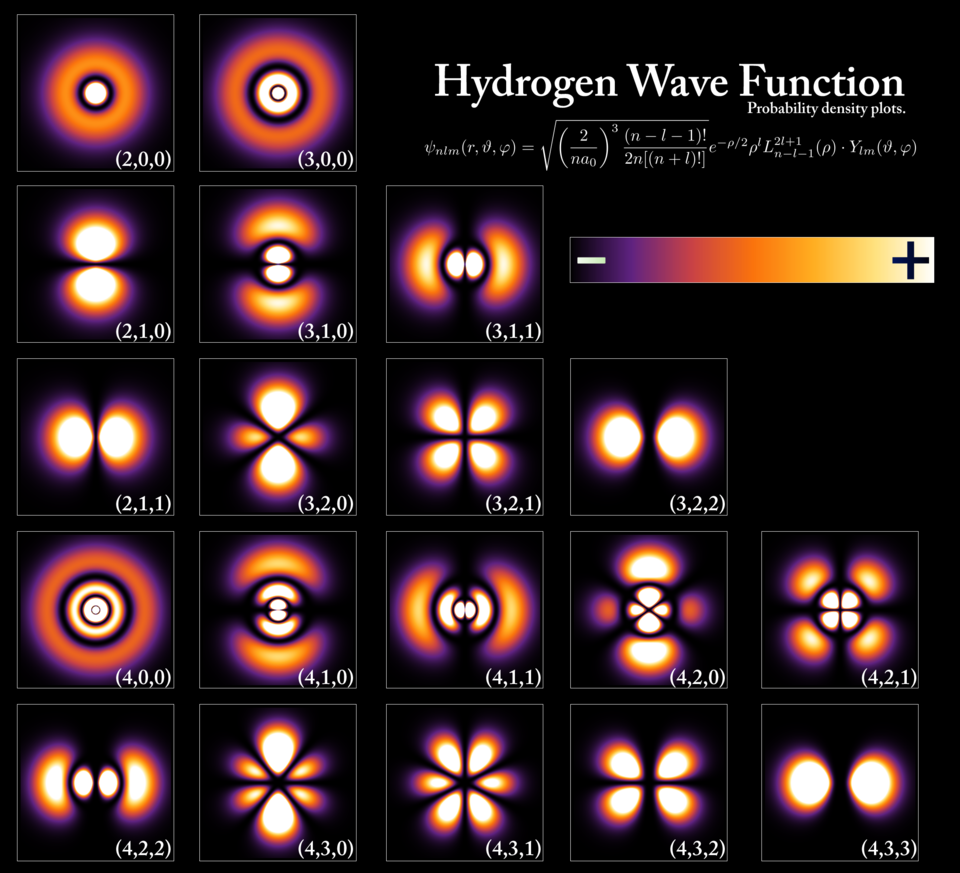
Quantum mechanics describes electrons using mathematical wave functions.
These wave functions determine where electrons are most likely to be found.
Instead of following fixed paths, electrons exist as probability distributions.
Scientists often describe these regions as electron clouds.
The cloud does not represent uncertainty caused by poor instruments.
It reflects the actual quantum nature of electrons.
The Strange Nature of Light
Light played a central role in the birth of quantum mechanics.
For centuries, scientists debated whether light consisted of particles or waves.
Experiments eventually showed something astonishing.
Light behaves as both.
Sometimes light creates interference patterns characteristic of waves.
Other times it arrives as individual packets called photons.
Neither description alone tells the complete story.
Quantum mechanics unites both ideas.
Light possesses wave-particle duality.
Its behavior depends on the experiment being performed.
Matter Behaves Like Waves Too
The surprises did not end with light.
Scientists soon discovered that electrons also produce wave-like interference.
Later experiments demonstrated wave behavior for atoms and even relatively large molecules.
This does not mean particles literally transform into water-like waves.
Instead, quantum objects possess properties unlike anything in everyday experience.
They cannot be fully described using classical categories.
Quantum mechanics introduces an entirely new framework.
Wave Functions
One of the most important ideas in quantum mechanics is the wave function.
A wave function is not a physical wave like an ocean wave.
Instead, it is a mathematical description containing information about all possible outcomes for a quantum system.
The wave function allows physicists to calculate probabilities.
Where might an electron be found?
How likely is a photon to pass through a certain opening?
What energy level will an atom occupy?
These predictions consistently match experiments with astonishing accuracy.
Although the mathematics can become complex, the basic idea is surprisingly simple.
Quantum mechanics predicts possibilities rather than certainties.
Probability Becomes Fundamental
Classical physics predicts exact results.
If you know a baseball’s speed and direction, you can calculate where it will land.
Quantum mechanics works differently.
Instead of predicting one guaranteed outcome, it predicts the probability of different outcomes.
Imagine flipping a perfectly balanced coin.
You cannot know the exact result beforehand.
You can only predict a fifty-percent chance of heads.
Quantum probabilities are more fundamental than ordinary chance.
They arise from the laws of nature themselves.
Experiments repeatedly confirm these statistical predictions.
Heisenberg’s Uncertainty Principle
One of quantum mechanics’ most famous discoveries is the uncertainty principle.
This principle states that certain pairs of physical properties cannot both be measured with unlimited precision simultaneously.
The best-known example involves position and momentum.
If you determine an electron’s position extremely precisely, its momentum becomes less certain.
If you determine its momentum precisely, its position becomes less certain.
This limitation is not caused by faulty instruments.
It reflects a fundamental property of quantum systems.
Nature itself places limits on what can be known simultaneously.
Superposition
Superposition is among the most fascinating concepts in science.
According to quantum mechanics, a particle can exist in multiple possible states before measurement.
This idea often surprises beginners because it sounds impossible.
Imagine a musical chord.
A chord contains several notes played together.
Similarly, a quantum system can exist as a combination of different possibilities.
When a measurement occurs, one outcome becomes definite.
Superposition has been observed countless times in carefully designed experiments.
It forms the foundation of quantum computing.
The Double-Slit Experiment
Few experiments have influenced science more than the double-slit experiment.
Scientists shine light toward two narrow openings.
Behind them sits a screen.
Instead of producing two simple bands, light creates an interference pattern.
This indicates wave behavior.
The real surprise appears when photons pass through the apparatus one at a time.
Even individual photons gradually produce the same interference pattern.
Each photon behaves as though multiple possible paths contribute to the final result.
If scientists measure which slit each photon passes through, the interference disappears.
Observation changes the outcome.
This remarkable experiment continues inspiring debate about the meaning of quantum mechanics.
Measurement in Quantum Mechanics
Measurement plays an unusual role in quantum mechanics.
In everyday life, observing something usually does not change it significantly.
Looking at a tree leaves the tree unchanged.
Measuring an electron is different.
Because electrons are so tiny, any measurement requires interaction.
That interaction affects the electron.
Quantum mechanics describes this process mathematically.
Exactly why measurements produce definite outcomes remains one of science’s greatest mysteries.
Different interpretations offer different explanations.
All agree on the experimental predictions.
Schrödinger’s Cat
Perhaps no thought experiment is more famous than Schrödinger’s cat.
It was never intended as a real experiment.
Instead, physicist Erwin Schrödinger invented it to illustrate how strange quantum ideas appear when applied to everyday objects.
The thought experiment imagines a cat inside a sealed box connected to a quantum event.
According to one interpretation of quantum mechanics, the quantum system exists in a superposition until measured.
Schrödinger asked whether this would imply the cat is both alive and dead before observation.
Most physicists agree this thought experiment highlights questions about interpretation rather than actual cats existing in impossible states.
The story reminds us that quantum mechanics challenges our intuition.
Quantum Entanglement
Entanglement is one of the most remarkable predictions of quantum mechanics.
When two particles become entangled, their quantum states become linked.
Measuring one instantly determines the corresponding property of the other, regardless of the distance separating them.
Albert Einstein disliked this prediction.
He called it “spooky action at a distance.”
Years later, increasingly sophisticated experiments confirmed entanglement.
Importantly, entanglement cannot transmit information faster than light.
Instead, it reveals deep connections within quantum systems.
Today, entanglement forms the basis of quantum communication and quantum information science.
Quantum Tunneling
Imagine rolling a ball toward a hill.
If the ball lacks enough energy, it rolls back.
Quantum particles sometimes behave differently.
They possess a small probability of appearing on the other side of barriers they seemingly should not cross.
This phenomenon is called quantum tunneling.
Although it sounds impossible, tunneling occurs throughout nature.
It enables nuclear fusion inside stars.
It contributes to radioactive decay.
It allows advanced microscopes to image individual atoms.
The Sun itself shines partly because of quantum tunneling.
Why Atoms Remain Stable
Quantum mechanics explains why matter exists.
Without quantum rules, electrons would collapse into atomic nuclei.
Atoms could not survive.
Chemistry would disappear.
Planets, oceans, and living organisms could never form.
Quantum energy levels prevent this collapse.
Electrons naturally occupy stable configurations.
This stability allows atoms to combine into molecules.
Molecules combine into cells.
Cells form living organisms.
Every breath you take depends upon quantum mechanics.
Quantum Mechanics and Chemistry
Chemistry is essentially applied quantum mechanics.
Chemical bonds form because electrons occupy quantum states.
The periodic table exists because electrons fill atomic orbitals according to quantum rules.
Every reaction in your body.
Every drop of water.
Every grain of salt.
Every strand of DNA.
All arise from quantum interactions among atoms.
Without quantum mechanics, chemistry would have no foundation.
Quantum Mechanics in Everyday Technology
Quantum mechanics may describe tiny particles, but its influence reaches into daily life.
Computer processors contain billions of quantum-designed transistors.
Lasers depend on quantum emission.
LED lights rely on quantum energy transitions.
Solar panels convert sunlight into electricity using quantum effects.
MRI machines detect signals from atomic nuclei.
Atomic clocks measure time with extraordinary precision.
GPS navigation depends on those clocks.
Whenever you unlock your smartphone or browse the internet, quantum mechanics is quietly working behind the scenes.
Quantum Computers
Quantum computers represent one of the most exciting applications of quantum mechanics.
Unlike ordinary computers that use bits equal to zero or one, quantum computers use qubits.
Qubits exploit superposition and entanglement.
This allows certain calculations to be performed much more efficiently.
Quantum computers are not faster for every task.
Instead, they excel at specialized problems involving chemistry, optimization, cryptography, and materials science.
Researchers continue improving these remarkable machines.
Quantum Mechanics and the Universe
Quantum mechanics does not stop at atoms.
It also influences stars, black holes, and the early universe.
The nuclear reactions powering stars rely on quantum tunneling.
Particles created shortly after the Big Bang followed quantum laws.
Even empty space contains quantum fluctuations according to modern physics.
Understanding the universe requires both quantum mechanics and Einstein’s theory of relativity.
Combining these theories remains one of science’s greatest challenges.
Common Misunderstandings
Quantum mechanics is frequently misunderstood.
Some people believe it allows anything imaginable to happen.
It does not.
Quantum systems obey precise mathematical laws.
Others think consciousness creates reality.
Mainstream quantum mechanics does not require this idea.
Measurements involve physical interactions, not necessarily human observers.
Some claim quantum mechanics proves supernatural powers.
No scientific evidence supports such claims.
The genuine discoveries of quantum mechanics are already astonishing without adding unsupported interpretations.
Why Quantum Mechanics Is Trusted
Quantum mechanics has survived more than a century of experimental testing.
Scientists have challenged it repeatedly.
Each time, it has produced remarkably accurate predictions.
Some calculations agree with experiments to more than ten decimal places.
Very few scientific theories achieve this level of precision.
Its extraordinary success explains why physicists rely on it with great confidence.
Although debates continue about its interpretation, there is overwhelming agreement that quantum mechanics accurately describes microscopic reality.
Questions That Remain Unanswered
Despite its success, quantum mechanics is not the final chapter of physics.
Scientists continue searching for deeper understanding.
How does gravity fit into quantum theory?
What exactly happens during measurement?
What is dark matter?
Can spacetime itself be described quantum mechanically?
Could entirely new discoveries await beyond today’s theories?
These unanswered questions drive modern physics.
Future generations may witness another scientific revolution just as dramatic as the birth of quantum mechanics itself.
Why Learning Quantum Mechanics Matters
Learning quantum mechanics is not merely about understanding atoms.
It changes how we think about knowledge itself.
It teaches humility.
Nature does not have to behave according to human expectations.
Reality can be stranger than imagination.
Quantum mechanics reminds us that careful experiments—not intuition—reveal the truth.
It also shows how curiosity transforms civilization.
The strange experiments performed over a century ago eventually led to computers, lasers, medical imaging, secure communications, and countless other technologies that shape modern life.
Every great scientific discovery begins with someone asking a simple question.
Quantum mechanics stands as one of humanity’s greatest examples of where that curiosity can lead.
Conclusion
Quantum mechanics is the scientific framework that explains the behavior of matter and energy at the smallest scales. Although its ideas often challenge common sense, they have been confirmed by countless experiments and have become essential for understanding the universe. From electrons inside atoms to the light emitted by distant stars, quantum mechanics reveals a hidden world where probability, waves, particles, and uncertainty work together according to elegant mathematical laws.
Its discoveries have transformed science, revolutionized technology, and deepened our understanding of reality itself. Every smartphone, computer chip, laser, and MRI scanner owes its existence to quantum principles. Even the stability of atoms and the chemical reactions that make life possible depend on quantum mechanics.
Perhaps its greatest lesson is that the universe is more imaginative than we once believed. The deeper we explore nature, the more we discover that reality is filled with surprising patterns waiting to be understood. Quantum mechanics is not simply a theory about tiny particles—it is one of humanity’s most profound windows into the true nature of the cosmos.